Cardio Clear 7 Official Website › Heart health supplement guide
The Heart Health Supplement Guide
The heart supplement aisle contains about eight ingredients that recur and a long tail that does not. Coenzyme Q10 and omega-3 have the largest trial literatures, plant sterols and red yeast rice have evidence for cholesterol, magnesium and nitrate donors have narrower cases, and several popular botanicals have almost nothing. This guide goes through each.
Written for somebody standing in front of a shelf. It names the ingredients this website does not sell as readily as the three it does.
What a heart supplement can and cannot be
Start with the category boundary, because everything else follows from it. A dietary supplement may make structure and function claims: statements about the normal working of the body. It may not claim to diagnose, treat, cure or prevent a disease. The FDA's explanation runs to two pages and is worth the five minutes.
That boundary is why every honest heart supplement label says supports rather than prevents, and it is also why so much of the marketing around these products lives in videos, landing pages and bonus reports rather than on the bottle. The bottle is the regulated surface. Everything else is where the claims go that could not be printed.
The second principle is harder to accept and matters more. Nothing in this aisle competes with the interventions that actually change cardiovascular risk. The NHLBI's heart-healthy living pages list them: not smoking, blood pressure control, physical activity, sleep, diet, and managing cholesterol and blood glucose where they need managing. The CDC's overview gives the scale of the problem. A supplement is an addition to those or it is nothing.
Coenzyme Q10: the largest literature in the aisle
Coenzyme Q10 is the ingredient this category is built on, and it has the most interesting evidence record. The Q-SYMBIO trial randomised 420 patients with moderate to severe heart failure to 100 mg three times daily and reported fewer major adverse cardiovascular events over two years. That is a genuine finding in a defined population.
Three Cochrane reviews complicate any attempt to generalise it. The heart failure review concluded the mortality evidence remains uncertain. The hypertension review found no convincing evidence of blood-pressure lowering. The primary prevention review found no completed trials reporting clinical outcomes in people without established disease, which is the population most buyers belong to. A meta-analysis of endothelial function is more positive, and the statin myalgia literature disagrees with itself.
The useful summary. Coenzyme Q10 is the best-supported thing in this aisle and the support is population-specific. If you have heart failure, discuss it with a cardiologist. If you are healthy and hoping to stay that way, the honest evidence for it is thinner than the marketing implies.
On a label, look for the amount and the form. Doses in trials run from 100 to 300 mg a day. Ubiquinone and ubiquinol are both used; ubiquinol is often claimed to absorb better and is more expensive. A product that names coenzyme Q10 without an amount cannot be compared to any of the above, which is a point this website makes at length about the product it sells.
Seven more ingredients, and what the evidence says
Eight groups, ordered roughly by the size of the literature behind them.
| Ingredient | What it is for | Evidence | What to check on a label |
|---|---|---|---|
| Omega-3 (EPA/DHA) | Triglycerides, and cardiovascular risk in specific groups | Large and genuinely contested. Prescription-strength EPA has its own trial record | The EPA and DHA amounts, not the fish oil total |
| Plant sterols and stanols | LDL cholesterol | Consistent modest reductions at around 2 g a day | Whether the dose reaches 2 g, which most capsules do not |
| Red yeast rice | LDL cholesterol | Works, because it contains a naturally occurring statin. That is also the problem | Monacolin K content, and whether your prescriber knows you take it |
| Magnesium | Blood pressure, rhythm | Modest, and mainly in people who are deficient | The salt form: oxide is poorly absorbed, citrate and glycinate better |
| Nitrate donors (beetroot, citrulline) | Blood flow, blood pressure | Short-term blood pressure effects are reasonably consistent | Nitrate content, which most beetroot products do not state |
| Garlic extract | Blood pressure, lipids | Small effects, highly preparation-dependent | Allicin yield, which is what varies |
| Hawthorn | Traditional cardiac tonic | Some older heart failure trials, little modern work | Extract ratio and standardisation |
| Shilajit, PQQ and similar | Energy, mitochondria | Thin. Small trials, mostly non-cardiac endpoints | Amount, purification and, for shilajit, heavy metal testing |
Notice what is not on this list: nothing here clears an artery, reverses plaque or replaces a medicine. Any product claiming one of those three is telling you something about itself.
The ingredients with reputations larger than their evidence
Two on the list above deserve a paragraph of their own, because they are the ones most likely to appear in a formula sold on energy and mitochondria.
PQQ. Pyrroloquinoline quinone has an attractive mechanism, mitochondrial biogenesis, and a small human record that is mostly about cognition. Tamakoshi 2023 used 20 mg a day and measured cognitive outcomes. There is no cardiovascular outcome trial. A product selling PQQ for the heart is selling a hypothesis.
Shilajit. The human trials are few and non-cardiac: a testosterone trial in healthy men at 500 mg a day is the best known. The more important literature is about purity, because raw mineral pitch can carry lead, arsenic and mercury from the rock it came out of, and a 2024 review is devoted to exactly that. Purified is the word that matters on a shilajit label, and it is a supplier claim rather than a tested one unless a certificate is produced.
- ›A mechanism is not evidence. Every ingredient in this aisle has one.
- ›A trial in a diagnosed population does not transfer to a healthy one.
- ›An ingredient with no published amount cannot be compared to any trial, at all.
- ›A traditional use is a reason to investigate, not a reason to conclude.
- ›NCCIH Know the Science is twenty minutes and will change how you read every label afterwards.
Four claims a heart supplement should never make
It prevents heart attacks
A disease claim, and outside what a dietary supplement may say. If a product implies it in a video and avoids it on the bottle, that gap is deliberate.
It clears or flushes arteries
Nothing sold as a supplement does this. Arterial plaque is not flushed, in three minutes or in three months.
It replaces your medication
The most dangerous claim in the category. Stopping a statin or a blood thinner on the strength of a supplement page is how this goes badly wrong.
Results in days
Nothing in this aisle works in days. A product that produces an immediate noticeable effect most likely contains a stimulant.
Buying one ingredient or buying a formula
A question the aisle raises constantly and answers badly. Most products here are combinations, most of the trial literature is on single ingredients, and the two facts pull in opposite directions.
The case for a single ingredient is that you know what you took, at what dose, and any change is attributable to one thing. The case for a formula is adherence: somebody who would take one capsule for six months but would not take four separate bottles is better served by the combination, and a supplement nobody takes has an effect size of zero whatever the trials said.
- Buy single ingredients if you are targeting one thing, if you want to compare to the research, or if a clinician has asked you to take something specific.
- Buy a formula if the realistic alternative is taking nothing, or if the ingredients you want happen to be in one and all of them are declared with amounts.
- Avoid a formula that hides its amounts, whichever camp you are in, because it removes the one thing that would let you judge either case.
- Never buy two products with an overlapping ingredient without adding the doses up. This is the most common accidental overdose in the whole category.
How to bring a supplement into a medical appointment
Take the bottle
Not a description of it, not a photograph of the front. A pharmacist can read a panel in fifteen seconds and will ask for things a description leaves out.
Say what you are taking it for
The answer changes the advice. Fatigue, a cholesterol number and a family history are three different conversations.
List everything else
Prescriptions, over-the-counter medicines and other supplements. Interactions are mostly additive and mostly boring, which is why they get missed.
Ask about the specific interactions
Warfarin and vitamin K antagonists, blood pressure medication, and anything handled by the liver are the three worth naming out loud.
Ask what would make you stop
A good answer is a symptom, a test result or a date. Without one, a supplement course has no end and no decision point.
Heart supplement questions
Which heart supplement ingredient has the best evidence?
Omega-3 fatty acids and coenzyme Q10 have the largest trial literatures, and both are population-specific rather than universally useful. Neither is a substitute for treatment.
Do heart supplements lower cholesterol?
A few ingredients have evidence for it, notably plant sterols and red yeast rice, and both come with caveats. Most heart supplements contain neither.
Is CoQ10 worth taking with a statin?
The trials disagree. The depletion argument is biologically real, the muscle-symptom meta-analyses conflict, and the honest answer is that it is a reasonable thing to try and not a settled one.
What should a heart supplement never claim?
That it prevents or treats heart disease, clears arteries, replaces medication, or produces a result in days. All four are outside what a dietary supplement may claim.
Every page, every journal post, the bottle facts and the ingredients go through review by Dr. Brenda McCool, ND before they ship. We write these pages from the printed Cardio Clear 7 bottle and the manufacturer’s own listing artwork, cite public research for coenzyme Q10, shilajit and PQQ, and print “not published” wherever a figure is not disclosed rather than estimating it. This label publishes no amount for any of its three ingredients, and that fact appears on every page where an ingredient is named. Where the seller’s marketing claims more than the bottle supports, we say so on the page. Corrections are made on the page itself and the review date moves forward. Write to [email protected]. Last reviewed September 2026 by Dr. Brenda McCool, ND.
Sources cited in this guide
- National Center for Complementary and Integrative Health. Coenzyme Q10. https://www.nccih.nih.gov/health/coenzyme-q10
- Mortensen SA, Rosenfeldt F, Kumar A, et al. The effect of coenzyme Q10 on morbidity and mortality in chronic heart failure: results from Q-SYMBIO, a randomized double-blind trial. JACC Heart Fail. 2014;2(6):641-9. https://pubmed.ncbi.nlm.nih.gov/25282031/
- Al Saadi T, Assaf Y, Farwati M, et al. Coenzyme Q10 for heart failure. Cochrane Database Syst Rev. 2021;2(2):CD008684. https://pubmed.ncbi.nlm.nih.gov/35608922/
- Ho MJ, Li EC, Wright JM. Blood pressure lowering efficacy of coenzyme Q10 for primary hypertension. Cochrane Database Syst Rev. 2016;3(3):CD007435. https://pubmed.ncbi.nlm.nih.gov/26935713/
- Flowers N, Hartley L, Todkill D, Stranges S, Rees K. Co-enzyme Q10 supplementation for the primary prevention of cardiovascular disease. Cochrane Database Syst Rev. 2014;(12):CD010405. https://pubmed.ncbi.nlm.nih.gov/25474484/
- Gao L, Mao Q, Cao J, Wang Y, Zhou X, Fan L. Effects of coenzyme Q10 on vascular endothelial function in humans: a meta-analysis of randomized controlled trials. Atherosclerosis. 2012;221(2):311-6. https://pubmed.ncbi.nlm.nih.gov/22088605/
- Kennedy C, Koller Y, Surkova E. Effect of Coenzyme Q10 on statin-associated myalgia and adherence to statin therapy: a systematic review and meta-analysis. Atherosclerosis. 2020;299:1-8. https://pubmed.ncbi.nlm.nih.gov/32179207/
- Tamakoshi M, Suzuki T, Nishihara E, Nakamura S, Ikemoto K. Pyrroloquinoline quinone disodium salt improves brain function in both younger and older adults. Food Funct. 2023;14(5):2496-2501. https://pubmed.ncbi.nlm.nih.gov/36807425/
- Pandit S, Biswas S, Jana U, De RK, Mukhopadhyay SC, Biswas TK. Clinical evaluation of purified Shilajit on testosterone levels in healthy volunteers. Andrologia. 2016;48(5):570-5. https://pubmed.ncbi.nlm.nih.gov/26395129/
- Hussain A, Ashraf H, Rehman AU, et al. Hazardous or Advantageous: Uncovering the Roles of Heavy Metals and Humic Substances in Shilajit with Emphasis on Heavy Metals Toxicity and Their Detoxification Mechanisms. Biol Trace Elem Res. 2024;202(12):5532-5553. https://pubmed.ncbi.nlm.nih.gov/38393486/
- National Heart, Lung, and Blood Institute. Heart-Healthy Living. https://www.nhlbi.nih.gov/health/heart-healthy-living
- Centers for Disease Control and Prevention. About Heart Disease. https://www.cdc.gov/heart-disease/about/index.html
- National Center for Complementary and Integrative Health. Dietary and Herbal Supplements. https://www.nccih.nih.gov/health/dietary-and-herbal-supplements
- National Center for Complementary and Integrative Health. Know the Science. https://www.nccih.nih.gov/health/know-science
- U.S. Food and Drug Administration. Questions and Answers on Dietary Supplements. https://www.fda.gov/food/information-consumers-using-dietary-supplements/questions-and-answers-dietary-supplements
- National Institutes of Health, Office of Dietary Supplements. Dietary Supplements: What You Need to Know. https://ods.od.nih.gov/factsheets/WYNTK-Consumer/
- Federal Trade Commission. Health Products Compliance Guidance. https://www.ftc.gov/business-guidance/resources/health-products-compliance-guidance
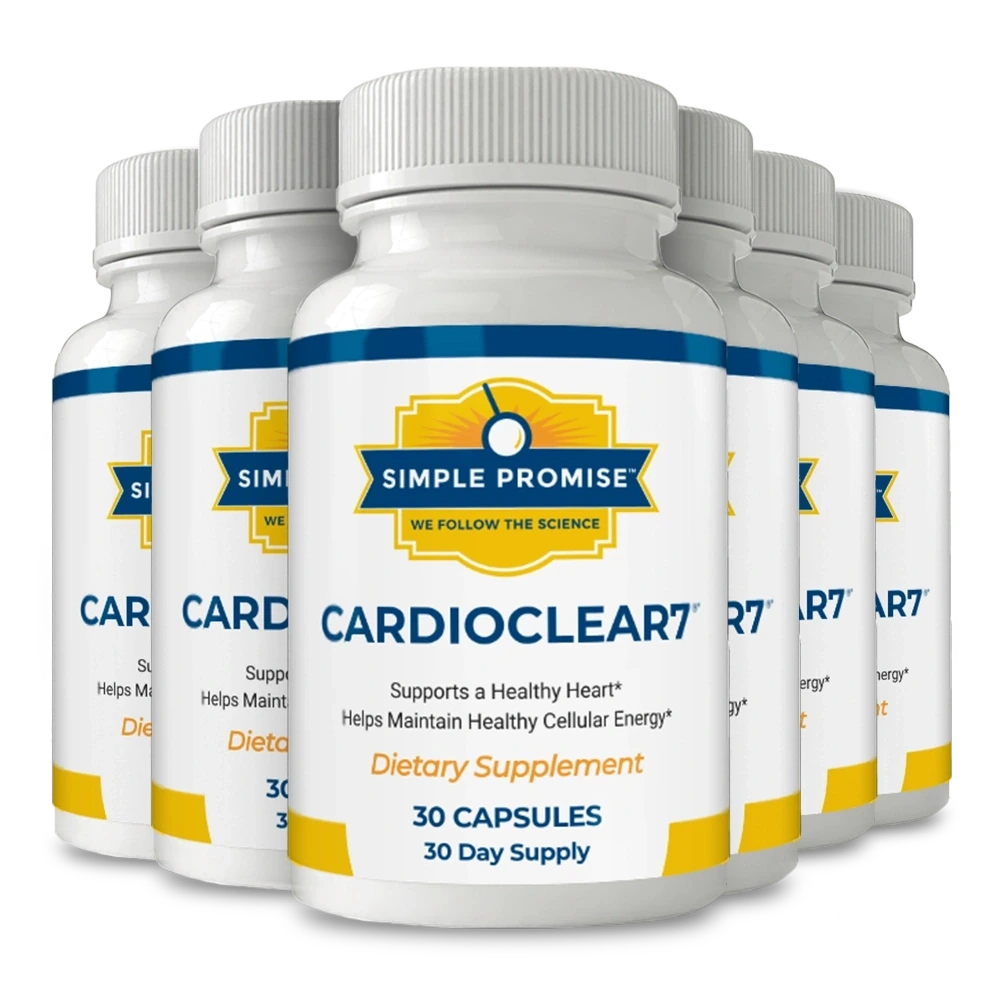
See how Cardio Clear 7 measures up
This guide was written for somebody who might buy nothing. If you want to see the product it sits beside, the ingredient pages are the place to start.
Price shown at checkout · 60 days to change your mind
Get Cardio Clear 7 — Price At CheckoutOne-time payment, no subscription · 60-day money-back guarantee · lot CAR-26/CA-5447 · order desk +1 (302) 200-3480